
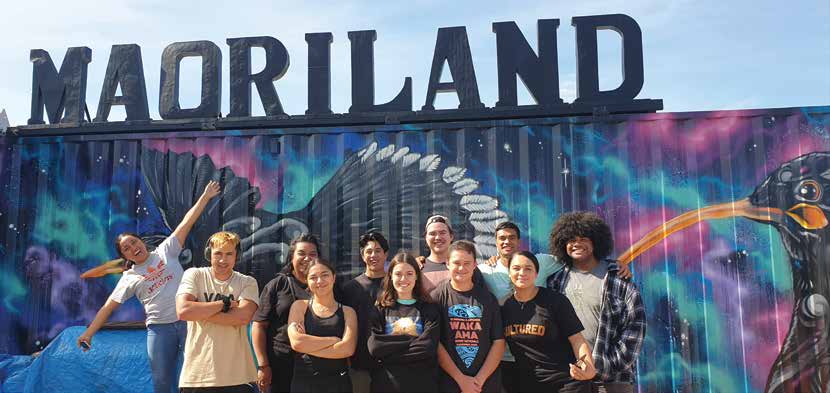
Māoriland is a charitable trust mandated by Ngā Hapū o Ōtaki, the five subtribes of Ōtaki. It has been established to support the social, economic and educational success of its community through connection to the wider world of Indigenous creativity and innovation.
The Trust had its beginnings in 2014 when Te Tumu Whakarae o Māoriland, Libby Hakaraia, alongside producer Tainui Stephens, lawn mowing contractors Tania and Pat Hakaraia and their niece Madeleine Hakaraia de Young, founded the first Māoriland Film Festival. In 2017, the organisation opened the Māoriland Hub, occupying a large and recently extended building in the centre of Ōtaki, with an art gallery and community garden.
Today Māoriland is the largest presenter of Indigenous screen content in the Southern Hemisphere. It also provides a year-round programme of workshops and internships for rangatahi. This is their Te Uru Maire Strategy. It has created a development pathway for rangatahi, engaging them at the community level, through to the high value world of film, creativity, innovation and technology. The vision is to ‘grow a forest of strong rangatahi creatives.’
They do this through a range of activities including the E Tū Whānau Film Challenge, the Māoriland Tech Creative Hub – M.A.T.C.H, and Ngā Pakiaka, the leadership group.
The E Tū Whānau Film Challenge is for rangatahi between the ages of 12–24 years.
Over the last nine years, the two-day workshop has been taken to Auckland and to smaller rural towns in the North Island. They’ve run over 50 workshops and worked with over 7,000 rangatahi. Te Waipounamu is on the agenda.
About 20 rangatahi who have already been through the Film Challenge and who are now part of Ngā Pakiaka facilitate the two-day workshops – in partnership with community groups from around the country.
The challenge to rangatahi is – make a film and tell your story about what it means to be rangatahi Māori. The film must be no longer than five minutes and respond to one of E Tū Whānau’s values: aroha, whakapapa, whanaungatanga, korero awhi and mana manaaki.
Madeleine de Young who leads Te Uru Maire, says that the young film makers are encouraged to make a film about issues that are important to them: “We are saying, your voice is important. We care about what you think. Share it with us so that we can share it with everyone. They are incredibly attuned to what is going on in the world.”
At a Kaitaia Film Challenge workshop in October this year a popular subject was the South Korean survival drama television series, Squid Game. Oriwa Hakaraia, Libby’s daughter and a founding member of Ngā Pakiaka, facilitated the workshop. Oriwa is just 18, still at kura, and did her first E Tū Whānau Film Challenge when she was 9. She said that several of the rangatahi at the Kaitaia workshop made their films about the issues raised by current Netflix sensation:
“Squid Game’s underlying theme is capitalism – very rich people versus very poor people.
“Story telling is powerful. We learn from our stories, whether they are legends about our ancestors (which are popular subject especially from young people who have been at a kura kaupapa), fictional or true. By telling our stories we learn who we are and who we can be – how we can change ourselves. When you tell your story you are showing the world who you are. You learn not to make decisions based on other’s opinions.
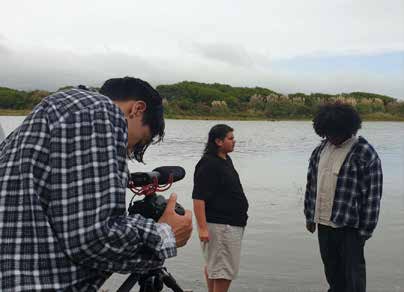 “At Kaitaia we had about 18 in the workshop. We create a space where it is safe for young people to make a short film – and show them just how simple it is. They work in small teams, so they learn teamwork and problem-solving skills. They learn how to present an idea – how to stand in front of a whole group and pitch their idea. They learn how to structure a story and to use all the film gear. They come to the workshop very shy and awkward. At the end of the first day they are pumped and ready to pitch their idea. By the end it is obvious that they feel more confident in themselves and in their Māoritanga. It is an eyeopener for a lot of them, realising that there is a place for us in the industry.”
Te Uru Maire aims to encourage rangatahi to use their voice as storytellers with passion and interest. It is a first step into the screen and creative tech sectors. Keen filmmakers may apply to the Ngā Pakiaka Incubator Programme where they are given the support and resources to make professionally-crewed short films. Oriwa alongside co-director Te Mahara took their debut film, Bub, to the Native Film Festival in Toronto, Canada. They are the youngest New Zealand directors to premiere a film at an internationally recognised Academy Award accredited festival.
Some rangatahi go on to be part of Ngā Pakiaka, the 20 or so strong leadership group which is responsible for organising the Māoriland Rangatahi Film Festival as well as the paid work of facilitating the Film Challenge workshops. Throughout the year these developing leaders are mentored and supported.
Rangatahi might also enroll (along with Ōtaki NEETS and motivated rangatahi from the kura) in M.A.T.C.H. This is a six-week Ōtaki-based programme followed by a 12-week internship. When we visited, they are were just completing the year-long pilot for this programme which is supported by the Ministry of Social Development.
JT who is the Manager at M.A.T.C.H. says that the Tech Hub gives aspiring filmmakers the fundamentals – skills in animation, storytelling, concept design, how to pitch an idea to get buy-in. The workshop is developed around a tuakana-teina model and is STREAMS focused – Science, Technology, Reading, Entrepreneurial, Arts, Mathematics and Sustainability.
Completion of each part of the programme is recognised by a micro credential that is recognised by the industry. “We’re not wanting our credentials to be part of the NZQA Framework,” says JT. “The tech industry moves so fast that in the time it would take to develop the standards the skill set would have changed. Industry organisations need to have influence over what the rangatahi are learning.”
And industry is keen to get motivated rangatahi with the right skills.
For those wanting to start out on their own, a recently established one-day New Business Start Up workshop provides rangatahi and others in the community with the basic business and taxation information that they need. “The creative industry is very project and contract driven,” says JT. “So knowing how to be self-employed is a key skill.”
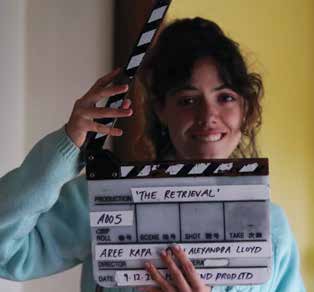 Through a Pākehā lens, Māoriland may look like another community-based educational provider. But’s it’s not. The kaupapa is the collective wellbeing. “We do not see ourselves as an educational organisation,” says Madeleine. “We are here for the social, economic and educational benefit of Ōtaki and our wider Māori and Indigenous screen sector.”
In a recent article, The Making of a Māori town: Ōtaki, published online by E-Tangata, the author, Tainui Stephens, points out that about 40 percent of the 6000 or so inhabitants of Ōtaki are Māori, of whom about half are able to use te reo. He notes that the town is home to the first Māori University, Te Wānanga o Raukawa, and that there are four kōhanga reo and two kura Māori, as well as bilingual and immersion units at the state and Catholic primary schools. “There are waiting lists everywhere,” he says.
Then there is the Māoriland Film Festival which every (non-Covid) year pulls in thousands of visitors, as well as their Te Uru Maire Strategy – growing forest of strong rangatahi creatives who are able to nurture and support others to grow alongside them.